

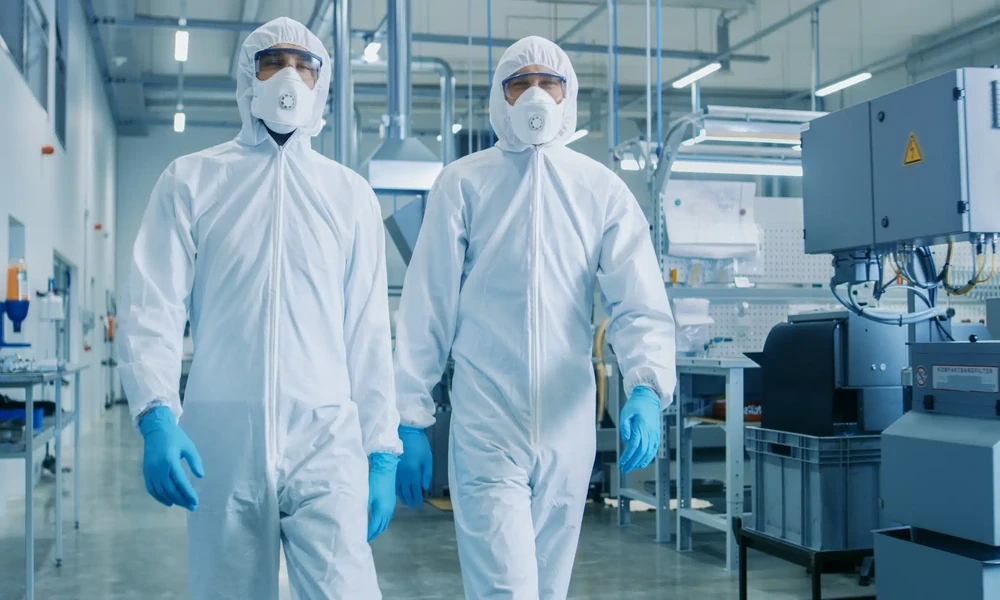
Particulate testing is the measurement of airborne particles in controlled environments and process spaces where contamination by particles affects the quality of the product, the safety of the process, or the health of the people working in the space. The discipline covers a range from cleanroom classification testing to workplace air quality monitoring, and the instruments and methods used depend on which end of that range an application sits.
What Particulate Testing Measures
Airborne particulate testing measures the concentration of particles at specified size ranges in a defined volume of air. The standard size ranges for cleanroom classification under ISO 14644-1 are 0.1 micron, 0.2 micron, 0.3 micron, 0.5 micron, 1.0 micron, and 5.0 micron. A particle counter draws air through an optical sensor and counts the light-scattering events that indicate a particle in each size range.
Industrial hygiene monitoring uses a different approach, collecting particles on a filter by drawing a measured volume of air through it, then weighing the filter or analysing it chemically to determine the mass concentration of particulate matter in the sampled air.
Both approaches answer the same fundamental question: how many particles, of what size, are present in this air at this moment? The answers determine whether a cleanroom meets its classification, whether a pharmaceutical manufacturing environment meets its regulatory requirement, whether a workplace air quality standard is being met.
Cleanroom Classification Testing
ISO 14644-1 cleanroom classification requires particulate testing at defined locations within the cleanroom, with the number of sampling locations determined by the floor area of the room. The measurement at each location must meet the particle concentration limit for the target classification across all relevant size ranges.
Classification testing is performed at initial qualification of a new cleanroom, after modification to the HVAC system or room configuration, and on a periodic basis to confirm that the cleanroom continues to meet its classification over time. Particulate testing for classification uses particle counters calibrated to ISO and traceable to national measurement standards.
Pharmaceutical Manufacturing Requirements
Singapore pharmaceutical manufacturers operating under the Health Sciences Authority’s Good Manufacturing Practice guidelines must demonstrate control of environmental particulate levels as part of their quality management systems. EU GMP Annex 1, which governs sterile pharmaceutical manufacturing, specifies particle concentration limits for each grade of manufacturing environment that must be demonstrated by regular particulate testing.
The limits for Grade A, which covers the critical zone immediately surrounding an open sterile product, are the most stringent. They require less than 3,520 particles per cubic metre at the 0.5 micron threshold during operation. Meeting and demonstrating this standard requires accurate instruments, a validated sampling programme, and rigorous data management.
As former Singapore Health Sciences Authority chief executive John Lim noted: “The framework we have built ensures that manufacturers who operate here are held to the standards that protect patients everywhere.” Pharmaceutical particulate testing is one component of that framework made practical.
Workplace Air Quality Monitoring
Outside the cleanroom environment, particulate testing for workplace air quality monitors total suspended particulates, PM10, and PM2.5 in industrial workplaces where dust, fumes, or other particulate matter is generated. The Workplace Safety and Health Act, administered by the Ministry of Manpower, sets occupational exposure limits for a range of particulate substances, and regular monitoring confirms compliance with those limits.
Industries where workplace particulate monitoring is required include:
- Woodworking and furniture manufacturing, where wood dust is a respiratory hazard
- Metalworking and welding, where metal fumes and particulate are generated
- Construction, where silica dust is a significant health hazard
- Food processing, where organic dust can create explosion risks
Mechlink Particulate Testing
Mechlink supplies instruments and services for particulate testing across cleanroom compliance, pharmaceutical manufacturing, and workplace air quality monitoring applications. Their particle counting instruments and sampling equipment cover the range from ISO cleanroom classification to occupational hygiene monitoring.
For Singapore facilities requiring reliable particulate testing to meet regulatory requirements or quality management standards, Mechlink provides the measurement resources and technical expertise to implement effective monitoring programmes.