

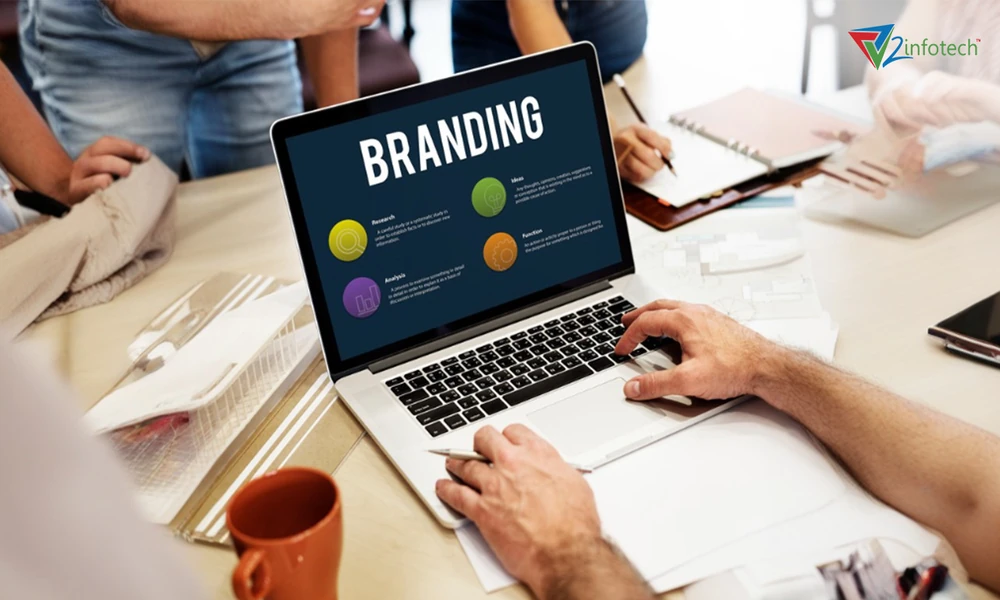
One positioning document connects a company’s name with its visual identity. Agencies write that page first, then build both outputs from it. Every candidate’s name must express the written claim. Every visual direction must express the same claim in parallel. Names and logos built this way arrive already matched at launch. Founders working alongside branding agencies for startups watch the discipline early, since candidate names get rejected for missing the positioning rather than for sounding wrong. Three working stages carry the connection from paper into a finished identity, and each stage leaves written records behind it.
Positioning writes the brief
Positioning is stated as one page before naming starts. Content stays concrete, what the company claims, for whom, and against which alternatives. Writing this page usually takes one structured founder session plus a competitor review.
- A claim of speed produces short, hard-sounding name candidates.
- A claim of care produces softer, longer sound families.
- Territory maps mark which claims competitors already crowd.
- Each surviving direction carries a written line tracing it onto the page.
Candidate lists run into dozens at first pass. Filtering against the page, pronunciation checks across target languages, and availability searches cut them fast. Names surviving all three filters move forward, holding written reasons per candidate. Those reasons matter beyond the current round. Months later, when visual work raises pressure against a name, the written case either holds or breaks. Either outcome moves the project forward with cause rather than mood, and the search never silently reopens.
Names face visual trials
Finalist names get drawn before anyone picks one. Each candidate becomes a rough logotype, an app icon, and a sample screen set. Sound and appearance get judged together this way rather than separately. Some names sound right aloud and collapse inside a sixteen-pixel favicon.
Trials run identical gates across every finalist for fair comparison. A nine-letter candidate loses small-size legibility, while a five-letter rival stays crisp. Doubled letters open symmetry for a future mark. Awkward ascender clusters block clean shapes entirely. Founders then pick while seeing each name already living inside product contexts, screens, icons, and headers together. Selection this way removes a common failure point, a loved name meeting its logo months later and satisfying nobody in the room.
Voice locks the match
Voice guidance closes the connection after the name settles. Rules get written around how the chosen name behaves inside sentences. Some names work as verbs. Some stay strictly nouns. Some invite shortening and some resist it completely. Written rules capture what the specific name allows and blocks.
Vocabulary, sentence rhythm, and formality all get set, matching the name’s character. A playful name inside sober enterprise copy reads as a mistake. Matched tone lets the same name fit every surface without friction. Guidance ends with one proof piece, a sample announcement where claim, name, visuals, and wording pull in one direction together. Anyone reading it sees the parts belong together rather than merely coexisting, and future writers copy its register directly.
Connection built through a written claim, drawn trials, and matched voice produces identities whose parts explain each other. A startup launching this way carries a name that looks correct inside its logo and sounds correct inside its copy. Meaning stays consistent because everything traces back to one page. Alignment this way comes from the method rather than accident, since every part follows the same written claim, and the records left at each stage keep it intact as the company grows.