

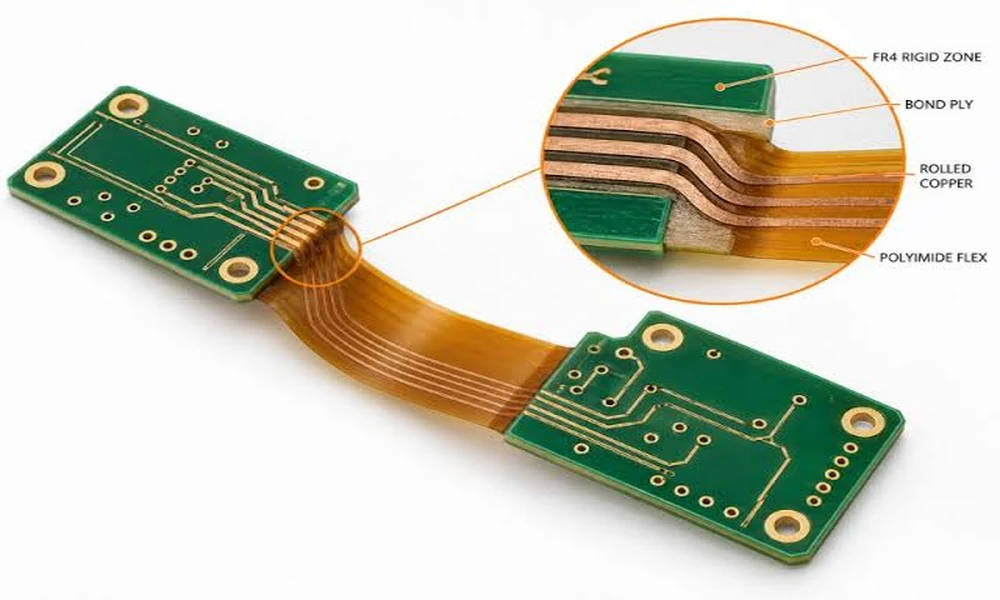
The right rigid flex PCB manufacturer can show IPC-6013 qualification, builds your stack-up in-house, and helps you fix bend zone problems before fabrication starts. Price and lead time matter, but one failed flex layer costs more than any difference between quotes.
Below is what to check, what to ask, and where most rigid-flex projects go wrong.
What Does a Rigid Flex PCB Manufacturer Actually Do?
A rigid-flex board combines rigid sections, usually FR-4, with flexible polyimide layers in one laminated part. The flex layers run through the rigid sections, so one board replaces the connectors and cables that would otherwise link separate boards.
That construction is harder to build than a standard multilayer board. The manufacturer has to laminate two materials that expand at different rates, drill and plate through both, and keep the rigid-to-flex transition zone free of cracks and voids.
Demand keeps climbing. SNS Insider puts the U.S. rigid-flex PCB market at $1.59 billion in 2025 and expects it to reach $3.18 billion by 2035. Medical wearables, defense electronics and automotive sensors drive most of that growth.
Which Standards Should a Rigid-Flex Manufacturer Meet?
The core standard is IPC-6013, the qualification and performance specification for flexible and rigid-flex printed boards. The current version, IPC-6013F, came out in 2026 and updates the requirements for rigid-to-flex transition zones, edge plating and board cavities.
IPC-6013 defines three performance classes. Class 1 covers general electronics, Class 2 covers dedicated service products, and Class 3 covers high-reliability products where failure isn’t an option, such as medical implants and avionics. Ask every supplier which class they build to and whether they provide cross-section reports with each lot.
IPC-2223 governs design. A good manufacturer checks your files against it before quoting, not after the first lot fails.
Why Bend Radius Is the First Thing to Check
Most rigid-flex failures start in the bend area. IPC-2223 sets the minimum bend radius from three inputs: flex thickness, the number of copper layers, and whether the bend is static or dynamic.
A common starting point for static bends is at least 6 times the flex thickness for single-sided flex, 12 times for double-sided, and 24 times for multilayer. Dynamic flex, which bends over and over in use, needs much larger ratios.
If your mechanical design can’t meet those numbers, a capable manufacturer will suggest fixes. Common options are fewer copper layers in the flex, an unbonded air gap construction, or moving traces and vias away from the bend line.
Questions to Ask Before You Order
Do they fabricate rigid-flex in-house?
Some suppliers broker rigid-flex work to overseas shops. That slows communication and makes defects hard to trace. Ask where lamination, drilling and plating actually happen.
What materials do they stock?
Polyimide is the standard flex material because it survives soldering heat and repeated flexing. Check that the shop stocks the cores and coverlays your stack-up calls for. Otherwise, material sourcing will add to your lead time.
Can they control impedance across the flex?
High-speed signals that cross from rigid to flex sections need impedance control in both. Ask for their tolerance and whether they test coupons on every panel.
Do they handle both prototypes and production?
Rigid-flex designs usually take two or three prototype spins. A supplier that handles quick-turn prototypes and volume production saves you from qualifying a new vendor halfway through the program.
Do you need domestic production?
Defense programs and some medical programs require U.S. fabrication. Confirm the supplier’s registrations and certifications before you send any controlled data.
Domestic vs. Offshore Rigid-Flex Manufacturing
Offshore suppliers often win on unit price at high volume. Domestic shops usually win on engineering access, shorter prototype cycles and supply chain security.
For low to mid volume, high-reliability builds, many engineering teams work with a U.S.-based rigid flex PCB manufacturer so design reviews happen in the same time zone and boards ship without customs delays. Avanti Circuits in Phoenix, for example, builds rigid-flex boards with polyimide flex layers and FR-4 rigid sections for medical, aerospace and defense customers.
Common Mistakes When Choosing a Supplier
The biggest mistake is choosing on quote price alone. Rigid-flex yields vary a lot between shops, and a cheap quote from a supplier with poor transition zone control can end in scrapped assemblies.
The second is sending files without a stack-up drawing. Mark rigid and flex regions, bend locations and bend type clearly on your fabrication drawing.
The third is skipping the design for manufacturability review. Most shops offer DFM feedback before fabrication, and it catches bend and via placement errors while they’re still cheap to fix.
The Bottom Line
Pick a manufacturer that builds to IPC-6013, reviews designs against IPC-2223, fabricates in-house, and can take you from prototype to production. Get those four right and the rest of the project gets much easier.