

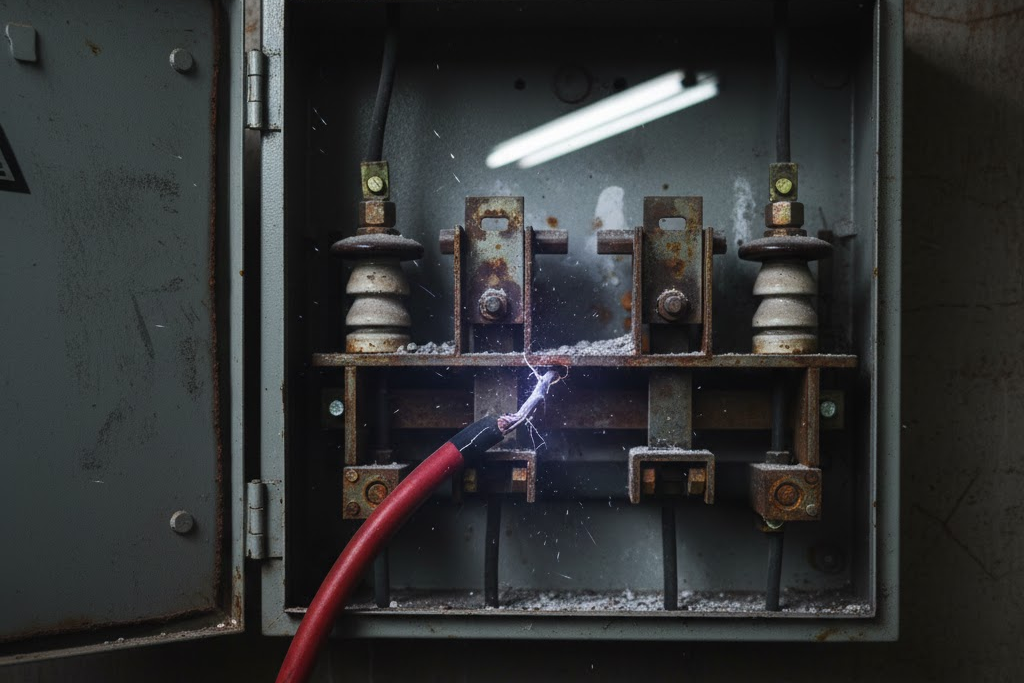
There is a fault condition occurring right now inside high-voltage electrical equipment across Singapore’s commercial and industrial buildings, and most of the people responsible for those buildings have no idea it is happening. It is called partial discharge, and its defining characteristic is that it leaves almost no visible trace until it is too late. No smell. No sound audible to the human ear. No warning light on a panel. Just a slow, invisible process of electrical degradation working its way through insulation material, weakening it incrementally, until the system fails in a way that is sudden, costly, and entirely preventable.
What Partial Discharge Actually Is
To understand partial discharge testing and why it matters, you first need to understand what the phenomenon itself involves. In any high-voltage electrical system, the insulation surrounding conductors and components is designed to prevent current from flowing where it should not. Over time, that insulation develops weaknesses: microscopic voids, cracks, contamination from moisture or dust, or delamination between layers of insulating material.
When voltage is applied across insulation that contains these defects, the electric field becomes uneven. In the weakest spots, the field is strong enough to cause a small, localised electrical discharge within the insulation itself. This discharge does not bridge the full gap between conductors. It is partial. But each time it occurs, it releases energy, generates heat, and produces chemical byproducts that degrade the surrounding insulation further. It is a self-reinforcing process. Each discharge makes the next one more likely, and more damaging.
Left undetected, partial discharge activity progresses from a minor insulation defect to a full dielectric breakdown, which in practical terms means a flashover, an arc fault, or an equipment failure.
What Causes It
The causes of partial discharge in electrical systems are varied, but they share a common thread: compromised insulation integrity. The most frequently encountered causes in commercial and industrial settings include:
- Voids or air gaps within solid insulation, often introduced during manufacturing or caused by thermal cycling over time
- Surface contamination on insulation materials, including moisture, conductive dust, and chemical deposits
- Delamination within multi-layer insulation systems, particularly in ageing cables and switchgear
- Mechanical damage to insulation caused by vibration, thermal expansion, or physical impact
- Deterioration of the insulating oil in oil-filled transformers, particularly when water ingress has occurred
- Design or installation defects that concentrate the electric field at sharp edges or poorly terminated cable ends
In Singapore’s tropical climate, humidity and heat accelerate many of these processes. Equipment that might remain serviceable for longer in a cooler, drier environment can deteriorate significantly faster when exposed to persistently high ambient temperatures and moisture levels.
How Detection Works
The challenge of partial discharge detection is essentially a challenge of signal recovery. The electrical pulses produced by partial discharge are real, but they are small and occur at high frequencies that standard monitoring equipment does not capture. Detecting them requires specialised instruments and trained engineers who know how to interpret what they find.
The primary detection methods used in Singapore’s commercial and industrial sector include:
- TEV (Transient Earth Voltage) testing, which detects the high-frequency pulses produced by partial discharge as they travel across the surface of metal-clad switchgear
- Ultrasonic detection, which picks up the acoustic emissions generated by discharge activity, either airborne or transmitted through solid material
- High-Frequency Current Transformer (HFCT) testing, which measures the high-frequency current pulses that partial discharge injects into the earthing system of cables and transformers
- Dissolved Gas Analysis (DGA), used for oil-filled transformers, which identifies fault gases produced by discharge and thermal degradation dissolved in the insulating oil
Each method has its particular strengths and is suited to different types of equipment and different stages of degradation. A thorough partial discharge assessment for a high-voltage installation typically combines several of these approaches to build a complete picture of the system’s condition.
The EMA’s regulatory framework for Singapore’s electrical installations supports condition-based monitoring as part of a structured maintenance programme. As the EMA’s guidance notes: “Regular inspection and testing of electrical installations helps detect deterioration before it leads to failure or danger.” Partial discharge monitoring sits at the centre of that principle, providing data about equipment condition that no visual inspection or conventional test can reveal.
Managing the Risk
Detection is only the first step. What matters is what happens next. A partial discharge survey that identifies activity in a piece of equipment creates an obligation to act, and the appropriate response depends on the severity and progression of what has been found.
For equipment showing early-stage activity, increased monitoring frequency may be sufficient in the short term, combined with an assessment of whether operational changes such as load reduction or improved ventilation can slow the progression. For equipment where discharge activity is advanced, the likely outcome is accelerated maintenance, component replacement, or managed shutdown before a failure occurs.
The key risk management principles for building owners and facility managers are straightforward:
- Incorporate partial discharge testing into scheduled maintenance programmes, particularly for switchgear and transformers older than ten years
- Keep historical test records to track changes in discharge activity over time, since trend data is often more informative than any single reading
- Respond to positive findings promptly, rather than deferring action until the next maintenance cycle
- Engage qualified LEWs with specialist condition monitoring experience for any high-voltage installation
The Broader Picture
Singapore’s commercial and industrial buildings depend on electrical infrastructure that is expected to operate reliably, around the clock, under sustained load. The gap between that expectation and the reality of ageing, degrading insulation is exactly where partial discharge lives.